
Quantum Computing and its impact on cybersecurity
The idea behind quantum computing is to resolve problems in various domains of mathematics, physics, chemistry etc. They are mainly deployed to perform operations that are super complex in nature and are beyond the computing of conventional computers. They basically work with the technology of qubits in which the control signals are operated upon. The qubits are represented using Bloch sphere, in which any point denotes a combination of qubits.
The functionality of qubits depends upon two states spin-up and spin-down. These states are governed by RF techniques and control signals.
IBM has recently announced a quantum computer with the capability of 50 qubits (quantum bits). This breakthrough has made IBM iconic in the field of quantum computing, as this has been the largest quantum computing system ever physically possible.
Before mentioning the facts and figures of quantum computing, we should drill the need for quantum computing and what does it serve even when the conventional computing methods have made their impacts at profound scale. The conventional computing methodologies involve the use of transistors for storing data in binary forms i.e. 0’s and1’s and process this data.
In 1960 ’s, Intel co-founder Gordon Moore perceived that the power of computers doubles roughly eighteen months and this is known as Moore’s Law. The computing problems require more storage as more information needs to be stored. Quantum computing is solely based upon a quantum theory which deals with the atoms and the smaller particles in them.
Quantum computers work on qubits which are represented as points on sphere i.e. 0and 1 are represented as north and south pole respectively, any point on the sphere is a reasonable qubit state which is a combination of 0 and 1 and algorithms such as Shor’s algorithm and Grover’s algorithm have proved to be computing at an enormous speed with quantum computers but it is not necessarily true that quantum computers are superiors to the conventional computers.
Quantum Computing May Be Closer Than You Think
Classical computers will not be replaced by quantum computers. Quantum computers are for solving problems which traditional computers cannot. They can help perform a large number of algorithms, calculations, and even run simulations. For example, vaccine development can be achieved in hours or days where it might take several years with classical computers. Quantum technology is capable of opening up a whole new world of possibilities.
Quantum Computing and the evolving cybersecurity threat
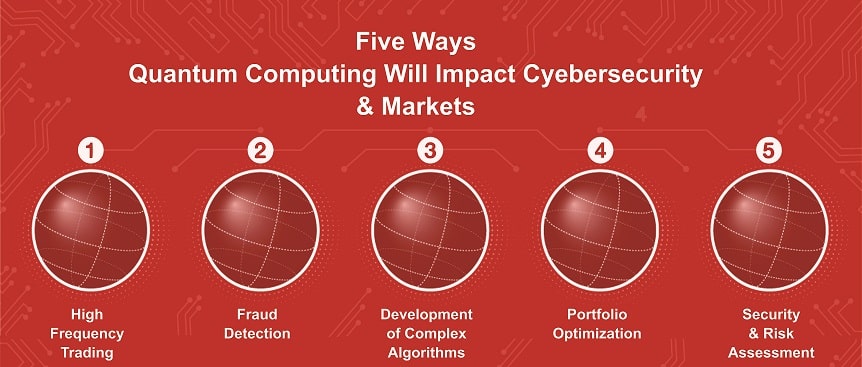
Many underlying foundational technologies that rely on public key encryption are potentially at risk with the advent of quantum technology. Quantum computers are a double-edged sword that can break our current encryption algorithms, but also open the door for more advanced systems. It can help various industries, including transportation in optimizing routes, finance industries in performing risk analysis, genetic engineering, chemical manufacturing and drug development, and weather forecasting.
Quantum Computers could crack Bitcoin
Quantum computers can be popular in terms of codebreaking; its capabilities can potentially introduce IT security issues. Encrypting doesn’t guarantee protection, it’s only a way to make the data harder to access. With a private key, one can easily create its corresponding public key, but not vice-versa. It could take millions of years for classical computers to find a match, but a quantum computer can easily calculate the secret private key in minutes. This means that cryptocurrency, like Bitcoins that depend on block chain technology, are at greater risk of quantum attacks.
A sufficiently powered quantum computer can make modern-day encryption look like a side quest in the hacker’s main gameplay. Developing quantum-resistant cryptography to thwart quantum hacking is the need of the hour.
The quantum computing cybersecurity threat ‘cannot be underestimated’
Quantum computing opens up incredible advances in computing such as the ability to factor large prime numbers at incredible speeds. Unfortunately, the same prime factor numbering underlies the security systems we use to secure data in transit and in other information security arenas.
Building a quantum computer and achieving quantum supremacy is not child’s play. It involves huge investments and carefully shielded, isolated environments operating at super cold temperatures. The quantum race is real and many countries have been investing in quantum computing.
Harvesting Attacks & the Quantum Revolution
The quantum revolution has already begun. Organizations should start thinking about best practices like “crypto-agility”, which is the process that enables an organization to replace traditional algorithms without having an impact on any other process in the organization. They should consider quantum-resistant cryptography, as the existing encryption protocols will become obsolete in a few years. This may not seem like an immediate risk, but given the challenges and potential need for mitigation surrounding new protocols, planning ahead is wise. It may take a few more years for the technology to be commercially available, but we should also remember that a few years back quantum computing seemed like a theoretical concept.
Tags: ManageEngine